Misted & Failed Rooflight Units in Sheffield
When a skylight clouds between the panes, the sealed unit has failed, not the glass. We replace the unit, or the whole rooflight when the frame is the weak part, across Sheffield and 30 road miles.

What fails in a rooflight
Most failures are one part. We replace that part, not the roof.
-

The edge seal
When it fails, moisture gets between the panes.
-

Gaskets around the glass
Perished rubber lets water track inside.
-
The flashing and kerb
A leak here can look like a failed unit, so we check first.
Faults we put right
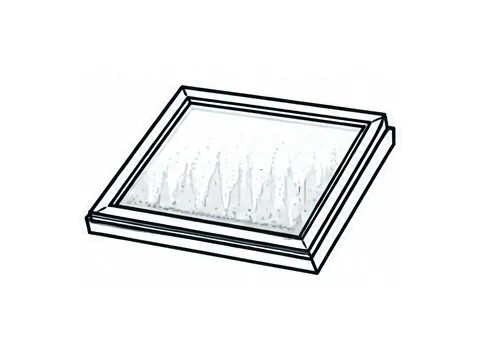 Misted between the panes
- Cracked or broken pane
- Perished seals
- Water at the kerb
Guides and answers on misted & failed rooflight units
The long read
The life of a sealed glass unit
A skylight that has clouded over is telling you something about its sealed unit, and the useful question is not only how to clear it but how the next unit will come out whenever it is due a change. This page follows a failed rooflight unit from the first smear of mist to the swap, and then on to the next one. Each stage is a place to check the unit again, and none is a forecast.
Spotting a failed rooflight unit: mist, drips and the other signs
A misted pane is the most obvious sign, but it is not the only one, and it is easy to confuse with ordinary condensation.
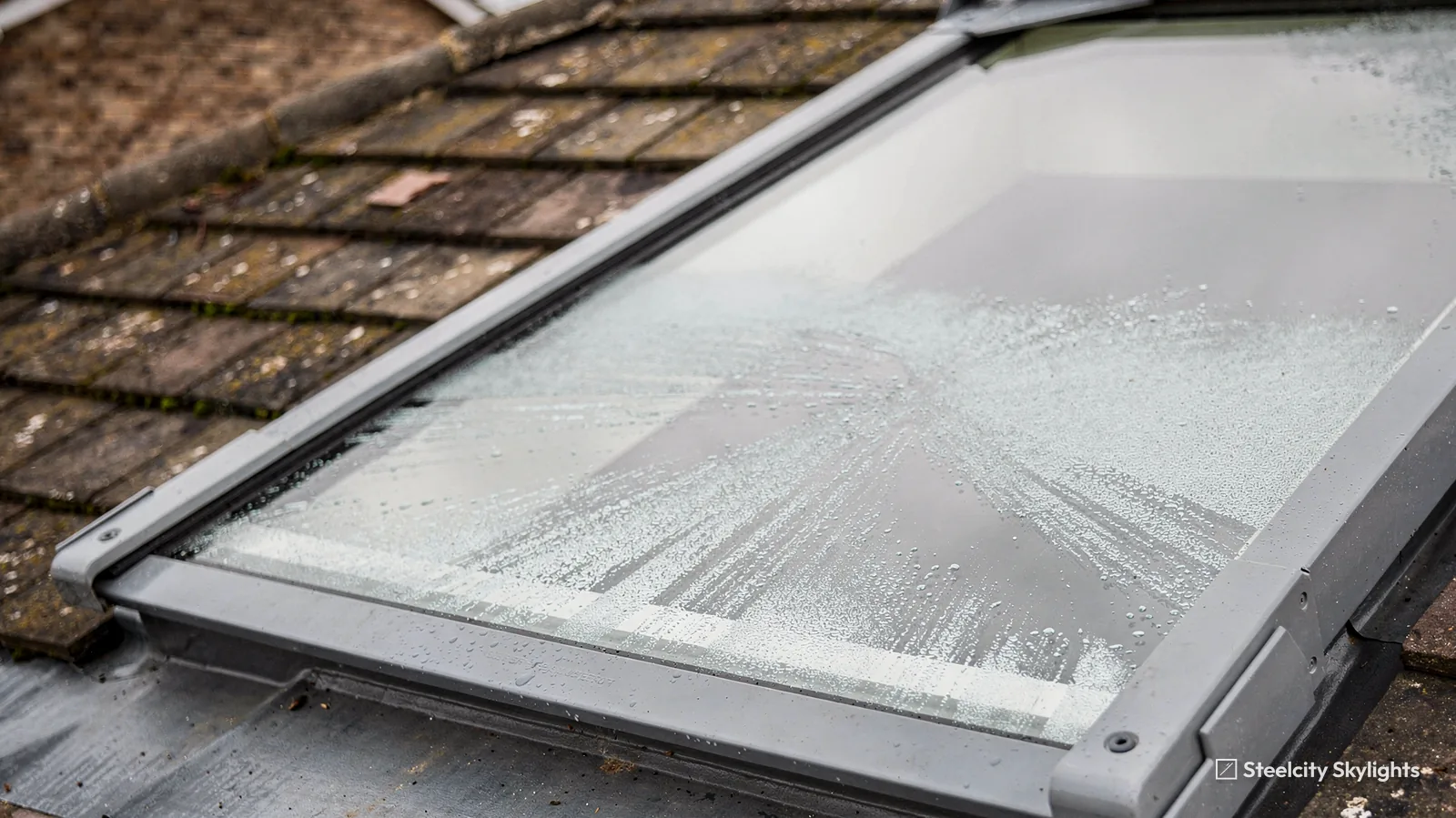
Picture a bright morning when the glass in the kitchen skylight looks as if someone has breathed on it, and the cloud does not wipe off. Wipe the inside and it stays. Wipe the outside and it stays. That tells you the moisture is sitting between the panes, in the gap of a sealed unit, where no cloth can reach.
- Sealed unit two or three panes of glass bonded round their edges with a spacer between them, closed so the gap stays dry
- Glazed unit another name for the same sealed unit, used when it is sold as a ready-made part
- Spacer bar the strip round the edge that holds the panes apart and carries the drying agent
- Desiccant the moisture-absorbing granules inside the spacer that keep the gap clear
- Edge seal the sealant layer round the unit that keeps outside air and water from entering the gap
- Rebate the groove in the frame in which the unit sits
Ordinary condensation behaves differently. It forms on the room face of the glass on cold, damp mornings, runs into beads, and clears as the room warms. It is a sign of humid air meeting a cold surface, often in a bathroom or a kitchen, and a clean cloth proves the point. Condensation on a rooflight also tells you something about the frame and the reveals, because a cold spot in the lining will collect it first. Misting between the panes is a different problem with a different cause, and treating one as the other wastes time.
Other signs that a unit has failed
It is worth ruling out the neighbours. A damp stain on the lining beside a skylight may point to a leak at the flashing, not to the glass, and the two have different fixes. Our short answer on misted glass or leaking flashing sets out how to tell them apart from the room below.
Old single glazing and newer double glazing
Rooflights fitted a few decades ago were often single glazing, a lone sheet of glass in a metal or timber frame. A single pane cannot mist between the panes, because there is only one. It can still fog with condensation, and it loses heat quickly, which is a separate reason to think about replacement. Any rooflight with two or three panes is double glazing or triple glazing in a sealed unit, and those are the ones that mist when the seal gives up.
Why a sealed unit mists: the edge seal and what lets it fail
A sealed unit is dry inside only for as long as its edge seal holds, and a rooflight puts that seal under more strain than a wall window does.
Myth: Misting means the glass itself has broken down.
Fact: The glass is fine. The sheets are the same clear glass they were on the first day. What has failed is the sealed edge round them, which is why the whole unit is exchanged for a new one rather than the panes being cleaned.
Take a sealed unit apart in your mind. Two sheets of glass face each other, held a set distance apart by a hollow metal or plastic spacer. The spacer is filled with desiccant, a drying agent that takes up the small amount of moisture trapped when the unit was made. Round the outside, a bead of sealant bonds glass to spacer and closes the gap from the weather. Many units are also filled with an inert gas to cut heat loss. As long as that outer sealant stays intact, the gap stays dry and clear.
Mist appears when it does not. Over years the sealant softens, shrinks or tears away from the glass, and damp air finds a path in. The desiccant absorbs what it can; once it is full, the surplus condenses on the cooler inner faces of the glass. That is the cloud. The gas fill is lost at the same time, because the same gap that lets damp air in lets the gas out. A misted unit is therefore also one that no longer insulates as it was made to.
Why rooflights are harder on seals
A window in a wall sheds rain. A rooflight lies back and takes it. The glass looks straight up at the sky, so it takes the full heat of the midday sun, the frost of a clear night and standing water along its lower edge. Skylights on a pitch face the same weather, and flat ones add pooled water, because they lie nearly level. A unit that is warmed hard in July and cooled hard in January moves slightly each time, and an edge seal that has to flex through thousands of those cycles can in time lift.
Glass only, or the whole rooflight? How to decide
The failed unit is often the only part that has aged, but not always, and the decision belongs to the frame as much as the glass.
Owners sometimes ask whether they must replace the entire window, as if a misted pane condemned everything around it. It does not. If the frame is sound, the flashing is dry and the sash still opens and shuts as it should, replacing only the glass unit is a sensible answer. A new sealed unit goes into the existing frame, the glass is held and weatherproofed again, and the rest of the rooflight stays as it is. Our short answer on replacing just the glass in a rooflight describes how that works in practice.
Replacing the whole rooflight is the better answer when the unit is not the weak part. We consider it when any of the following are true.
| What we find at survey | Glass unit only | Whole rooflight |
|---|---|---|
| Frame sound, flashing dry, one unit misted | Suits the job | Not needed |
| Frame rotten or corroded | New unit would not seat | Suits the job |
| Water stain beside the opening | Does not address it | Considered with the roof around it |
| Single glazing, thin frame | Often cannot take a double unit | Suits the job |
| Maker no longer supplies the unit | Made-to-measure unit may still be possible | Considered |
Signs that point to the whole rooflight
- The window frame is rotten, warped, corroded or split, so a new unit would not seat properly.
- The rooflight is old single glazing, and the frame is too slim or too shallow to take a modern double unit.
- There is a leak at the flashing or the kerb, which is a separate defect that a new pane will not cure.
- The maker has stopped supplying the unit for that model, or the glass was bonded in and cannot be lifted out.
- The opening mechanism, hinges or seals around the sash have failed too.
- The frame limits what the glass can do: it cannot take a laminated inner pane, a solar coating or the warmth that a better unit would give.
Roof windows on a pitch: changing the pane from inside the room
On a pitched roof the glass unit is held in the sash, and the sash is often reached from the room below.
A pitched roof window has a sash, the opening part, hinged in a fixed frame that is fitted into the roof. The sealed unit sits in the sash. On many roof window systems the sash can be released from the frame, and the unit is taken out of the sash and replaced without touching the roof covering or the flashing. For these, much of the work is done from inside. We lay dust sheets, release the sash, take out the old unit, fit the new one in fresh seals, refit the sash and test it.
That matters on the slate roofs of Walkley, Crookes and Heeley, where getting onto the roof means scaffold or ladders and a good deal of care. A job that can be done from inside the loft room is lighter on the house, and it leaves the slates and the flashing alone. The sash is the part that moves, so it also tells you more about the rooflight as a whole than the glass does. If it drags, sticks or shows corrosion in its hinges, we note it at survey.
Centre-pivot and top-hung sashes
The two common types behave differently. A centre-pivot sash turns on a horizontal axis near its middle: the upper half tips in and the lower half swings out, so a chair or a desk can stand beneath it. Many top-hung models can also be rotated for cleaning from inside, which makes the outer face easy to reach when the sash is out. Both types hold their sealed unit in the same way, and we confirm which you have at survey from the maker's label on the frame.
Reading the size code
The label on the frame carries a size code, such as MK04 on a VELUX. The letter is the width and the digits are the height. With the code and the maker's name, a replacement unit can be ordered to match without anyone measuring the glass from a ladder. Where the code is painted over or the label has gone, we measure the rebate and the daylight opening. Our answer on better glass at the point of a unit change explains what can change and what has to stay.
If you want to know more about the brand, our hub on VELUX windows covers sizes, models and what the codes mean. For roof windows more widely, see the roof windows page.
Flat rooflights and lanterns: when the unit comes out from the roof
A flat rooflight or a lantern sits on a kerb, and its glass is held from above, so the swap starts from the roof, not the room.
A flat rooflight is a sealed glass unit in a frame, lying almost level on a kerb above the flat roof. A lantern is a raised glazed shape on a flat roof, with several panes between bars. In both, the glass is usually held from the outside, by a clamped trim or by caps screwed over the bars. That makes the unit reachable from above but not from the room. The work starts on the roof, with safe access and a clear working space. Flat roofs on rear extensions in Hillsborough, Woodseats and Handsworth, where an extension was added to a terrace or a 1930s semi, are the places this comes up.
| Type | Unit held by | Reached from | Roof covering disturbed? |
|---|---|---|---|
| Pitched roof window | The sash | Usually the room | No, where the sash lifts out |
| Flat rooflight, clamped | Trim and gaskets | The roof | No |
| Lantern, capped bars | Top caps on each bar | The roof | No |
| Bonded glass in any type | Structural sealant | Often both | Possibly |
The good news is that the unit can come out without the roof covering. On a well-detailed rooflight, the clamp or cap is released, the old unit is lifted out, and the new one is set on fresh gaskets or tape and clamped down again. The kerb, the membrane that turns up it and the insulation round it stay where they are. Where the glass is bonded in, or the caps are of a pattern the maker no longer supplies, the same job becomes much larger. That is the question this whole hub exists to answer before you buy: if the unit ever mists, can the glass be bought and swapped without lifting the roof?
Our pages on flat roof rooflights, roof lanterns and walk-on rooflights cover each type, including glass made for foot traffic, whose heavy laminated units need lifting gear. Our 10-year guarantee covers the weatherproofing of the refitted trim and gasket seating round a swapped flat-rooflight unit; the unit itself sits under the maker's terms.
Frame material, glass type and size: uPVC, timber, aluminium and the glass in them
The frame decides how the new unit sits and how it will be swapped next time; the glass decides how it behaves in the room.
Frame material shapes the swap before it begins. A unit has to fit the rebate it is going into, to the millimetre, and each frame material treats that rebate differently.
The three frame materials
Timber frames take a unit well while the wood is sound, though a wet sash rots at the bottom corners first. uPVC does not rot, but it can bow in strong sun and give the unit an uneven seat. Aluminium, ideally thermally broken, is the slim frame of most flat rooflights and lanterns, and its caps or pressure plates make a unit easy to reach.
Glass type: laminated, toughened and patterned
A new unit is specified, not just matched. Over living space, the inner pane is usually laminated: two sheets bonded by a plastic interlayer, so if the glass breaks the pieces stay in place instead of falling into the room. The outer pane is commonly toughened, which makes it stronger and breaks it into small blunt pieces. The same combination suits a kitchen, a bedroom or a landing, where people stand and sit directly under the glass. For safety, and because laminated glass also resists a forced entry from the roof better, we put it forward for any unit above a room people use. Security is a quiet benefit of the same pane.
Obscure or patterned glass is chosen for privacy. A bathroom skylight or a rooflight that overlooks a neighbour may be better with obscure glass in a frosted or patterned finish (and a rooflight on a side-facing slope fitted under permitted development has to be obscure-glazed), and the choice has to be made at the order stage, because the pattern is part of the glass. Solar control glass cuts the sun's heat in a south-facing room, and a self-cleaning coating helps rain clear the outside. Each is one more layer in the specification and one more line in the life plan.
Size and thickness
Units are made-to-measure, and bespoke in the sense that each is cut and sealed to your frame. Three measurements matter: the width, the height and the overall thickness of the unit, which has to fit the depth of the rebate. A modern double unit can be thicker than the original, and a slim frame may not have room for it. We take all three and compare them with the frame's rebate before we order, and we do not guess from the outside.
Where a thicker or better unit will not fit the old frame, that is the point at which we say so plainly and put the entire window forward as the better option.
Energy efficiency of the replacement unit, and what Building Regulations say
A new sealed unit should do more than clear the cloud: it is the best chance in a generation to improve how the rooflight holds heat.
Myth: A new double unit always saves a fixed amount of heating.
Fact: The saving depends on the glass it replaces, the frame round it, how well the sash closes and how large the rooflight is against the room. We state the specification we fit and the standard it meets, and we do not promise a figure on your bills.
A misted unit has lost its gas and let in damp air, so it loses more heat than it did new. Replacing it with a modern unit improves matters. Today's units use low-emissivity glass, a fine metallic coating that sends heat back towards the room, together with warm-edge spacers, which are less conductive than the older metal ones, and an argon fill. Together they make a unit that is much more energy-efficient than a sealed unit from the 1990s, and far better than single glazing.
What the rules ask for
The energy rules for existing homes are in Approved Document L, volume 1, 2021 edition, Table 4.2. For a new or replacement roof window, the limit is 1.4 W/m²K, or a Window Energy Rating in Band B. For a rooflight, including a roof lantern, it is 2.2 W/m²K. The rules apply where the work is a replacement of the window or rooflight. Changing only a misted sealed unit in a sound frame is treated as a repair rather than a replacement window, so those limits are not formally triggered. We still specify a modern low-emissivity unit and name its figure in the quote.
Building Control, from the homeowner side
Replacing a window or rooflight in an existing home is controlled work, so it needs notifying unless a competent person scheme member carries out the job. We handle the notification where the job needs one, through the council or a registered building control approver, as private bodies have been called since April 2024. What you receive at the end is the paperwork: a completion certificate or the approver's confirmation, which goes in the house file and answers the question at the point you sell. When the job is a glass-only swap that the rules do not treat as a notifiable replacement, we tell you that at survey and do not raise a notice for the sake of it.
The replacement process, and how long a unit swap takes
The swap is short compared with the weeks of waiting for a made-to-measure unit, and most of the care goes into the edges.
It begins with the free survey. We look at the glass, the frame and the roof around it, from inside and, where it is safe, from outside. We read the maker's label, measure the rebate and the unit, check the sash, and look for the signs that would change the answer: rot, corrosion, a stain, a drainage path that is blocked. Our free quote is a fixed figure on paper, and it carries the life plan: the unit named, the parts that wear and how each is replaced, including whether that disturbs the roof.
Units are made after the measurements are agreed, so a short gap follows the survey. How long the swap takes depends on the number of units, the access, the weather and what the frame turns out to need; a lantern with six units takes longer than a single sash, and our short answer on how long a glass unit swap takes goes through the stages.
The day itself
- We protect the room below with sheets and clear the space under the rooflight.
- We set up safe access. For a pitched window that may be from the room; for a flat rooflight or lantern it is from the roof.
- The old unit is released from its trim, beads or caps and lifted out. We check the rebate and the frame as it is uncovered, since the true condition of a frame shows only when the glass is out.
- The rebate is cleaned, new gaskets, tapes or setting blocks go in, and the new unit is set in position.
- The trim, beads or caps are refitted, and the sealing round the unit is completed.
- We test the sash and, where the rooflight is flat, run water over the joint to check it before we leave.
- The glass is cleaned, the room is left clear, and the old unit is taken away.
What changes the cost, and the areas we cover across South Yorkshire
The figure depends on the roof as much as the glass, so we quote after we have seen both.
We do not publish a price for a unit swap, because the same misted pane on two roofs can be very different jobs. One is a sash that lifts out quickly from the loft room; the other is a rooflight 4 metres up on a rear extension behind a terrace. The survey costs nothing and the written quote is fixed, so the number you accept is the number you pay, and we install to that quote.
Is a unit swap cheaper than a new window?
Often it costs less, because the new part is smaller and the roof is not opened. It is not always the better value. A new unit in a tired frame that fails again, or in a frame that cannot take the better glass, is a poor use of money. We lay both options side by side in the quote and say which we would choose and why.
Areas we cover
Installation and replacement is all we do, and we work within 30 road miles of the city centre. That takes in South Yorkshire, with Rotherham, Barnsley and Doncaster, north Derbyshire towards Chesterfield and Bakewell, north Nottinghamshire towards Worksop, plus the border country of West Yorkshire and the Peak. Houses in the western fringe of the city, such as those at Bradfield or on the Hope Valley side, may fall inside the Peak District National Park, where the National Park Authority is the planning authority and not Sheffield City Council. A glass-only swap seldom raises a planning question, but a new rooflight in a different position can. For the rules, see our planning and Building Regulations guide.
Year 15: planning the next swap before the first one is done
The best time to decide how a unit will be changed is on the day it goes in, when every part is in view.
Nothing here sets a date for a seal to give up. When we fit a new unit we record its maker, size, glass specification and the way it is held, so the next one can be ordered by reference. We look at the edge seals at year 5, 10 and 15, mostly with a torch from the room, to catch the first haze while it is small. A conservatory roof with misted glazed units fails the same way, and the same question about its frame applies.
Before you book the swap: owners' questions about clouded units
Can misted double glazing be cleared without replacing the unit?
Once moisture is inside the gap the edge seal has failed, and clearing the cloud does not restore the seal or the gas fill. The sound answer is a new sealed unit, which we fit into your existing frame where the frame is in good order.
Do I have to replace the whole rooflight if one unit is misted?
Not if the frame, the flashing and the sash are sound. We look at the frame at survey and say whether a glass unit alone will do, or whether the frame is the weak part and the entire window should go.
Will a new unit improve energy efficiency?
A modern sealed unit with low-emissivity glass and an argon fill loses less heat than a failed one, and far less than old single glazing. The frame and the sash still count, so we state the specification and the Part L standard it meets and do not promise a saving on your bills.
Can you replace the glass in a VELUX window?
We can, where the unit is made for that model. The size code on the frame label, such as MK04, gives the width and height, and we confirm the rest at survey. Where the pattern of unit is no longer made, we say so and explain the other options.
Can I upgrade to laminated or patterned glass at the same time?
Usually, provided the new unit fits the depth of the rebate. Laminated glass for the inner pane, obscure or patterned glass for privacy, and a solar control coating are all choices made when the unit is ordered, since they are part of the glass.
How long does the swap take, and will you leave the roof open?
A single unit is a short visit, though the day depends on access, the number of units and the weather. A flat rooflight is closed and weathertight at the end of each working day, and we test the joint before leaving.
Will you come out to Rotherham, Barnsley or Chesterfield?
Thirty road miles from Sheffield brings in all three, together with Doncaster, Worksop and the Peak edge. The free survey and fixed written quote are the same wherever the rooflight is.