A roof window is chosen twice: once for the size of the hole, and once for the way the sash moves. The second choice is easy to leave until the order form, and it should not be. How a window opens decides where the handle sits, how far you can lean out, what you can reach from inside to clean, and which rooms it suits. This guide sets the two main types side by side, the centre-pivot and the top-hung, so that the decision is made at the survey with the room in front of you.
How each type moves
A centre-pivot sash turns on pins set about half-way up the frame. The handle is on the top rail. Pull it down and the upper half of the sash tips in towards the room while the lower half swings out over the roof. Push it on through and the sash rotates almost the whole way round, which brings the outer pane to face you.
A top-hung sash hinges along the top of the frame. The handle is on the bottom rail. It opens outward and upward, the way an awning does, with the lower edge lifting away from the frame and the sash staying outside the room. If you search for a top hung skylight, a top-hung roof window is what you will be shown.
Both sit in the same kind of frame, both go through the same flashing, and both can be glazed to the same standard. The difference is the hinge line, and nearly everything else follows from that.
Centre pivot vs top hung: the practical differences
People search for centre pivot vs top hung as if one had to win. Neither does. They are two answers to different rooms, and the table below shows where they part company.
| Question | Centre-pivot | Top-hung |
|---|---|---|
| Where is the handle? | Top rail, so the window suits a sill set higher up the slope | Bottom rail, so it suits a window you reach from standing height |
| What happens when it opens? | Upper half tips into the room, lower half out over the roof | Whole sash lifts out and away from the room |
| Cleaning the outer pane | Rotate the sash and wipe it from inside | On many models, VELUX GPL among them, the sash also rotates for cleaning from inside |
| View out | Clear once the sash is shut, with a small gap when open | The raised sash sits across the view and acts as a small canopy |
| Furniture below | Furniture can sit below, as the top of the sash tips in above it | Nothing swings into the room |
| Where it sits well | Loft rooms, landings, stairwells, rooms where the window is above head height | Bedrooms and studies where the sill is near eye level, and dormer roofs with a low window |
Read across a row and you can see the pattern. A centre-pivot is the better tool when the window is high and you want to clean it without a ladder. A top-hung is the better tool when the window is low and you want to look out of it.
Handle height and reach
Handle height is where most disagreements about this choice are settled. A window that cannot be reached comfortably is a window that stays shut, and a shut window is only half a roof window.
On a centre-pivot, the handle is at the top of the sash. If the window is set so that its top edge is at or just above head height, the handle is where your hand falls. If the window is set lower, the handle ends up down by your waist and the whole sash opens into the space where you are standing. For a bedroom with a low sloping ceiling, that is awkward.
On a top-hung, the handle is at the bottom. A window set at a normal sill height, with the handle at about the level of a kitchen counter, is easy to open and easy to close. A top-hung window set high on the slope puts the handle out of reach, and only a pole or an electric control will work it.
At the survey we stand in the room with a tape and ask where the window head and sill land when the frame is set into the rafters. The roof pitch and the height of the ceiling at that point settle which handle position is possible. We do this on the day, because the same window on a different pitch behaves differently.
Where a switch rather than a handle suits the room, an electric operator can be specified for either type. That is a separate choice, covered on our VELUX windows page, and it changes the wear parts we list in the life plan.
Cleaning, and what you can see when the window is open
Cleaning is a strong point of the centre-pivot. The sash turns right round and locks in place, so you can wipe the outer pane from a standing position indoors, with no ladder and no climbing on the roof. For a window in a stairwell, over a landing or above a bath, that is a real gain.
A top-hung opens outward for everyday use. Many models, the VELUX GPL among them, can also be released to rotate the sash for cleaning from inside, but not every top-hung design does this, so we check the exact model. On a window high above a staircase, where the handle sits out of reach, the centre-pivot is still the easier one to clean.
The view works the other way. A top-hung window, once raised, puts a lid over the view like a hat brim, and you look out under it. A centre-pivot, once opened, has the sash lying across the middle of the opening, so its edge splits the view. Neither is a full-height gap. Put the two in a bedroom with a low sill, though, and the top-hung gives the better outlook for someone sitting on the bed.
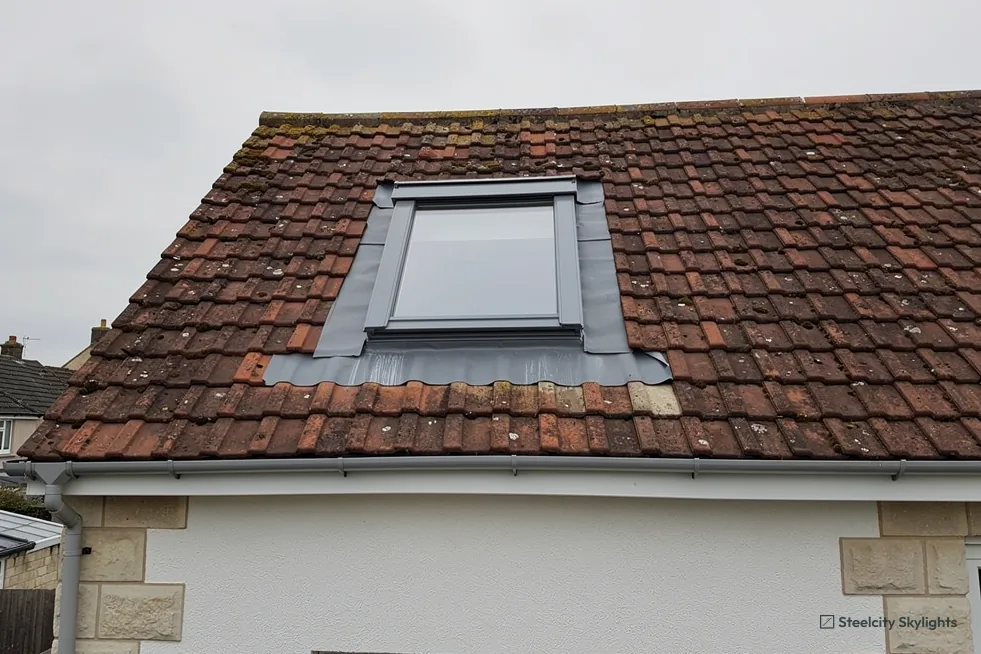
Ventilation and fresh air
Both types ventilate in two ways. The sash itself opens, which gives a full air change on a warm afternoon. A small vent along the top of the frame, a slot that opens with a flap or a control, lets in a trickle of fresh air with the sash shut. In a bedroom that is left closed at night, or a bathroom that needs to clear steam, the trickle vent often does more work than the sash.
The difference between the types is a matter of how the air moves. A centre-pivot opened a short way lets air in at the bottom and out at the top, so a warm room can ventilate itself on a still day. A top-hung opened a short way lets air in under the raised edge and out around the sides. Either is enough for a bedroom or a landing. What counts more is that the vent slot is above head height when the sash is shut, so the draught does not land on anyone.
Rain is the other half of ventilation. A top-hung sash, being raised outward, acts as a small canopy against rain falling at a steep angle, so the room can stay ventilated in light showers. A centre-pivot opened the same distance is more exposed. The trickle vent solves that for both, since it works with the sash shut.
Pitch, position and the roof around the window
Every roof window type is rated for a range of roof pitch, and that range comes from the maker. On a very shallow roof, a particular type may not be offered, or may be offered only with a particular kit. On a steep roof, the other way round. We read the maker's data sheet against the measured pitch at the survey, so the choice is not made on a guess.
Position on the slope matters just as much. Set a window so its top edge is near the ridge and you get the most light into the room, but a handle on the bottom rail will be too high to reach. Set it near the eaves and a top handle is too low. The tidy answer is to place the window where the sash type you want will work, then check the rafter spacing and the chimney or valley position to see if the opening can go there.
The flashing needs the same thought. The kit that seals the frame into the roof covering is chosen for the covering, slate or tile, and for the way the frame sits. The flashing kits guide sets out how, and the page on slate roofs covers the Sheffield stock where the question comes up. When we cover the flashing we also stand behind it: our 10-year guarantee covers the flashing work where frame meets roof, as well as the fitting itself.
Escape, size and the rules that apply
A roof window can serve as a means of escape from a bedroom in a loft, but the rule bites on height: Approved Document B counts an escape window only for a floor no more than 4.5 m up. The sash must also open wide enough to leave 0.33 m² clear, with 450 mm in both directions. Where a loft sits above two floors, the escape route is a protected stair, not a roof window. Whether a particular centre-pivot or top-hung model gives that clear opening is a question for the maker's data and the room measurements. Our page on roof windows as a fire escape sets it out.
The energy rule applies to both types equally. Approved Document L (2021) gives roof windows in existing houses a limit of 1.4 W/m²K, or WER Band B, whether the window is new or a swap. That is a different figure from the 2.2 W/m²K for a rooflight such as a lantern, and it is the figure that governs any roof window set into the slope of a pitched roof, whichever way it opens. Because the work is controlled, it is notifiable unless a competent person scheme member does it, and we handle that notification as one step in the job, between the survey and the handover.
Size is a separate matter, covered by the VELUX letter and digit code. The letter gives the width and the digits give the height, so a frame marked MK04 tells you what it will fit into without guesswork. Both sash types come in the same size grid, which makes the choice of type independent of the size of the opening. Where to put the window is covered on the page about where a roof window can be fitted.
What wears, and what the life plan records
Our approach is the long run, so we look at wear before we look at the first day. On a centre-pivot, the parts that take the strain are the pivot pins and the friction that holds the sash at the angle you set. On a top-hung, they are the hinges and the stays that hold it open. Both types have a perimeter seal, a sealed glass unit, a handle and, if fitted, a blind with brackets.
In the life plan, each of these parts is named, with a checkpoint rather than a promise: the seals get a look at year 5, the hinge or pivot action at year 10, and the glass unit at survey intervals after that. The plan also says how each part is replaced. On many roof windows a glazing unit or a sash part can be swapped from inside, without lifting the covering. That is something to confirm for the exact model before you rely on it, and the plan records the answer for the window we fit.
That record is the practical difference between a window that is sold and a window that is looked after. If a pivot stiffens or a seal softens in ten years, whoever works on it can see from the plan what was fitted, what size, with what flashing, and how each part comes out.
Choosing between the two
Is a top-hung roof window the same as a skylight?
It is one kind of skylight. The word covers any glazing set into a roof, including fixed windows and flat rooflights. A top-hung roof window is a sash that opens outward from a hinge along its top edge.
Which type is better for a loft bedroom?
It depends on the sill height. A window you reach from the bed or the floor suits a top-hung, with the handle at the bottom. A window set high above the bed suits a centre-pivot. Escape rules come into it too, so we measure the room first.
Can I swap a centre-pivot for a top-hung in the same opening?
If the frame size matches and the pitch suits the new type, it can be done. The handle moves from the top rail to the bottom one, so we check that it is within reach. The flashing and internal finish are renewed as part of the change.
Do both types come with blinds?
Blinds are separate items that fit either type, and we list them in the quote. The brackets sit on the frame, so they appear in the list of wear parts.
Does either type need more upkeep?
They need the same owner care: wipe the seals, keep the vent slot clear, and note any stiffness in the hinge or pivot. The life plan sets out when we look at each part.