Skylights & rooflights in Mosborough
Mosborough is a small old village with a large area of later housing wrapped around it, and the two want different things from a rooflight. We fit skylights and rooflights for both, and the quote lists which parts age first and how they are exchanged, without a major reopening of the roof.

Mosborough's roofs, and the light they leave out
The later housing here tends to be laid out in loops and closes with houses of a similar age and shape. That makes a rooflight easier to specify, and it also means the same few weaknesses repeat from door to door: pitched roofs that hide a dark landing, and rear extensions that cut a room off from daylight.
-

Steep pitches with lofts nobody uses
Many of the later houses carry a steep tiled roof with a roomy void under it. That space is often full of boxes. A roof window on a steep slope sits more upright than on a shallow one, so the view is better and the glass sheds rain more readily, but we plan access for the scaffold and the unit carefully.
-
Rear extensions with a gloomy middle
Gardens here are often long enough that owners have built outwards. A conservatory or a kitchen-diner on the back leaves the heart of the room far from any window. A lantern or a flat rooflight fixes that, once we know how the joists span.
-
Wooded valley edges
Streets near the Moss Valley sit among trees, and leaf fall, moss and shade all affect a rooflight. We ask where the nearest tree stands and plan for gutters and glass that need cleaning, so the maintenance is in the plan from day one.
The homes of Mosborough and its edges
The old village centre keeps a handful of stone cottages and farm buildings around the main street, many of them altered over the years. Their roofs are the ones needing hand work: stone or clay coverings, older timbers, and ridges that have settled slightly. Any rooflight there is chosen to be slim and set low in the slope, and the covering lifted around it is laid back in order.
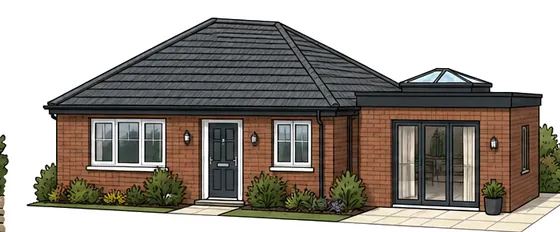
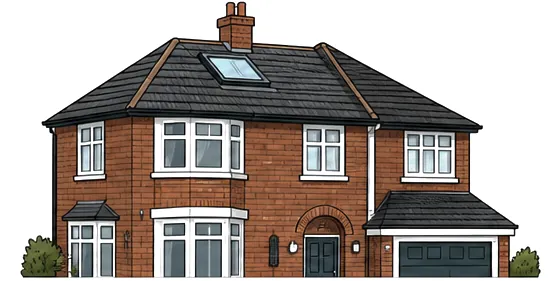
Most of the place, though, is later housing built in estates, and these have a character of their own. The streets curve, the houses are brick under tile, and many have integral garages with a room above. The roofs are often simple pitched forms in repeating patterns, so a survey in one road teaches us something about the next. That helps in a practical way: the rafter size, the pitch and the tile type are quickly established, and the quote can be accurate.
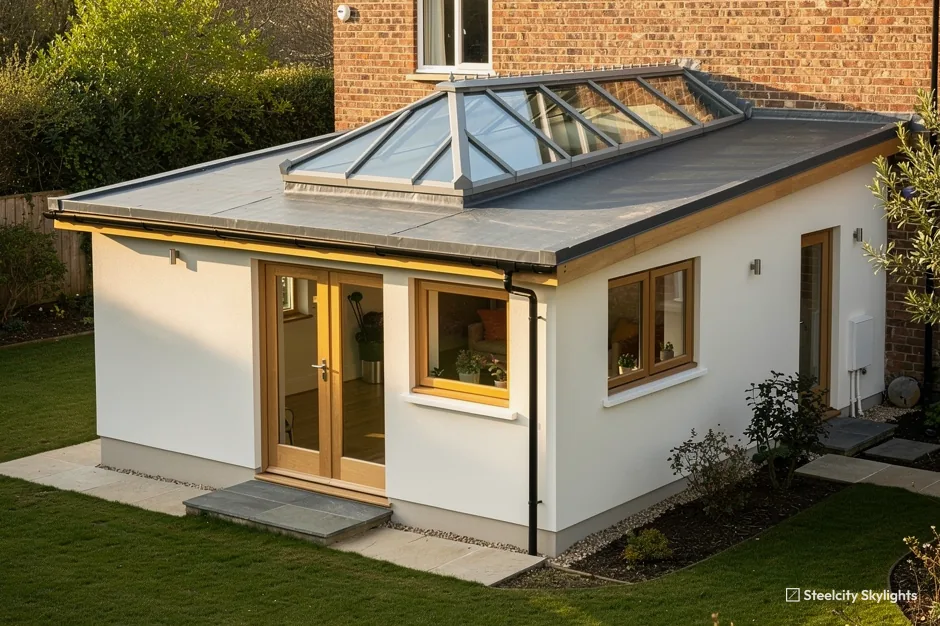
Rear extensions are the most common addition. A flat or low-pitched roof over a single storey is the usual location for a lantern, and these roofs are generally easier to work than the original slope, as long as the structure under them is known. We open a corner in the ceiling or look from the loft to find out which way the joists run, and what the covering is.
Over towards the valley, larger detached homes sit on bigger plots, some with a loft already converted. Windows installed years ago in these loft rooms are a frequent replacement job, since the sealed units fail while the frames are sound. The second thing we look at on a replacement is whether the flashing around the old frame can be reused, or whether it has to be redone. In both cases, the opening already exists, so the structural work is done.
Garages with a room built above them are a feature of the estate roads, and a good many of those rooms are used as offices now, and the roofs over them often have a low pitch that ends in a hip or a gable. A rooflight in that room is possible, but the pitch decides the unit: on a low slope, a flat rooflight or a low-profile roof window sheds water more reliably than a standard frame. Where the room is used as a bedroom or office, the ventilation matters as much as the daylight, so we usually discuss an opening sash with the owner. The same rule applies to a roof void above a bathroom. Steam should leave the building, not collect around the frame.
The estates also hold a good number of homes where children have grown up and left. Owners in that position often ask for a lighter, brighter kitchen, or for a box room to be turned into a study with a window of its own. Both are straightforward when the roof is simple, and the survey takes less time on a regular estate roof than on an old stone one, though we still check every rafter and every slate or tile.
Solar gain deserves a mention on the south and west faces of the estate roads, where a large roof window can warm a loft room quickly on a bright afternoon. We talk through blinds and glass coatings at survey, so that the room stays usable in July as well as January.
Think about the rear extension with a lantern over it. Over the years the parts that tire are the sealant lines where glass meets frame and the flat covering where it turns up the kerb; the glass itself tends to outlast both. A blind, the handle or motor on an opening vent and the internal trim are all reachable from your side of the ceiling, so none of them needs a ladder. The covering and outer seals are done from above, and the quote says which is which. At survey on one of these extensions we ask how old the flat covering is, because a new lantern on a tired roof means lifting the whole edge again. We also read the kerb height and the ceiling below.
What we fit in Mosborough
The pattern here is lofts that could hold a room and extensions that need more daylight. We fit roof windows and lanterns, replace worn units, and set out the plan for each part in the written quote, including whether a later replacement touches the roof or not.
 Roof WindowsInto steep tiled slopes above landings and box rooms, where the angle gives a good outlook and sheds rain.
 Roof LanternsOn the long rear extensions that gardens here allow, bringing daylight to the middle of a kitchen-diner.
 VELUX WindowsTo replace tired roof windows in loft conversions where the frame is sound and the glass or flashing has failed.
 Electric & Opening RooflightsFor lights high above a stairwell, where a switch opens the sash and clears warm air from the top of the house.
 Walk-On RooflightsWhere a rear extension has a roof terrace or a first-floor balcony above, and the glass has to carry people.
 Energy Efficient RooflightsFor wooded-edge homes that lose heat in winter, with glass and frames chosen to hold a room warm.
Consent and conservation in Mosborough
Sheffield City Council
Mosborough lies inside the City of Sheffield, so the city council decides planning and the city's policies apply. A roof window in a house is normally permitted development; the conditions are national, so they sit on our Building Regulations and planning page and not here. A tall lantern, a unit on a front slope or a new opening in a side wall each gets a second look from us.
National planning data shows two conservation areas close to Mosborough: Eckington and Renishaw Park, and Moss Valley. Both lie over the boundary in North East Derbyshire, so at survey we check Sheffield's own map against your address as well. A house inside a boundary is shown a flush conservation unit, with a plain explanation of its effect on the front slope.
Homes on the southern edge, facing the valley, are the ones where that check matters most. On the later estates there is usually no extra control, though we confirm that instead of assuming it.
None of this sits inside the Peak District National Park.
Conservation areas
Planning data names two conservation areas near Mosborough, Eckington and Renishaw Park and Moss Valley, both just over the boundary in North East Derbyshire. We check the map against your address at survey, then explain what applies to your roof.
Mosborough and the Moss Valley edge
Eckington lies barely a mile south, with Killamarsh nearly two miles east and Swallownest further north-east, about three miles away. Waverley is some four miles north, Staveley and Brimington lie south, and Kiveton Park is to the east at around the same four-mile mark. Dronfield sits to the west, about five miles off, over the county line in Derbyshire. Each of these has its own page: Eckington and Killamarsh share a lot of Mosborough's housing, while Dronfield and Staveley bring older stone and different roofs.
Mosborough
From a Mosborough survey to the tenth winter
-
Survey
A visit that settles the roof
Mosborough is 8.4 road miles south-east of Sheffield, a drive of around 16 minutes, and the survey costs nothing. Up in the loft we measure rafters and pitch; outside we look at how a ladder or scaffold would get to the roof. If trees overhang, we note them. Where the address is near the valley or the old centre, the conservation map is checked at the same visit.
-
Day on the roof
Opening, trimming and sealing
The covering is lifted, the rafters or joists trimmed, and the frame is set square. Flashing is dressed to the tile profile, which on repeating estate roofs is quick to match. The notification to Building Control is one of the steps in the job, handled by us, and the certificate follows. We bring the guarantee into the conversation at the flashing, since that is where it has most to do.
-
After the leaves
Checking glass under the trees
A first autumn near the wooded edges shows how much debris the roof collects. A rooflight that collects leaves in its corners may need a sweep, and the frames should drain freely. We tell you what to look for and how often to do it, and the plan for the gutter line is in the quote.
-
Year 10
Parts the plan said would need attention
By the tenth winter the plan from your quote has become a short list: gaskets, the sealed glass unit if it has misted, and the motor or sensor on an opening light. Each of these can be replaced from indoors or through the opening, and the roof around the frame stays as it was.
What Mosborough homeowners ask before a rooflight goes in
Does my Mosborough road sit inside a conservation boundary?
Planning data names two nearby, Eckington and Renishaw Park and Moss Valley, both on the Derbyshire side of the boundary. We check the map against your road at survey and tell you before we put a quote together.
Do steep roofs make a roof window harder to fit?
They change the job without making it harder. A steep slope gives a more upright window and sheds rain well, but it asks for safe access and a careful scaffold. That is planned at survey.
Can a room over the garage take a roof window?
Usually, yes. The pitch over a garage is often low, so we may suggest a flat rooflight or a low-profile roof window that sheds water on a shallow slope, plus an opening sash for ventilation.
Can an old loft-room window be replaced without redoing the roof?
Often, yes. If the frame is sound and only the sealed unit or the flashing has failed, we can swap those parts. The survey says which, and the quote says how each part would be changed again in future.
Will trees near my house affect a rooflight?
They can, through leaf fall, moss and shade. We note the trees at survey and choose glass and a layout that can be cleaned easily. The maintenance advice goes into the written plan.
Do you work in Eckington, Killamarsh and Dronfield too?
Yes. Each has its own page on this site with its own housing and planning notes, and the survey is free everywhere in our area.
Can the covering around a Mosborough lantern be renewed without taking the lantern out?
It depends on the upstand. If the kerb stands high enough and the glazed unit is fixed to it with a clear joint, the flat covering can be worked up to the kerb and re-sealed while the lantern stays in place. If the covering is trapped beneath the frame, the unit has to come off first. We note which applies at survey, and the life plan in the quote records it for later years.