Skylights & rooflights in Deepcar
Deepcar and Stubbin sit low in the Don valley with stone houses climbing the slope behind them. Valley weather, steep plots and stone coverings shape every skylight and rooflight we put forward here, and the quote names the part that wears first and how it is changed.

Valley roofs and what they ask of a skylight
A village in a narrow valley has its own weather. Cloud sits low, the wind funnels along the river, and houses on the upper streets look straight down the dale. The unit that sits happily on a sheltered street can struggle two rows up the hill.
-
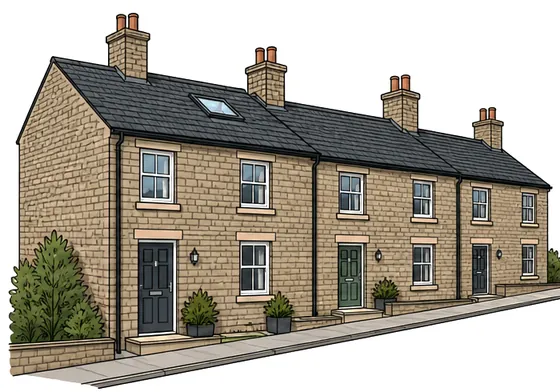
Stone terraces on a slope
Streets here step up the hillside, so roofs sit at different heights and the ridges run with the contour. Stone slate or heavy tile covers many of them, and the weight of that covering is a reason to look at the rafters before promising a clean opening.
-
Damp air that settles in the valley
Mornings in the valley bottom are often still and damp, and glass that mists on the room side is a sign of humid air, not a failed unit. We tell the two apart at the visit, because they need very different fixes, and a vent is cheaper than a new pane.
-
Little room to work
Plots are tight, gardens are small, and some streets are steep and narrow. Delivering a long lantern frame or setting up a scaffold takes planning, and we ask about access, parking and the neighbours before we price the job.
How Deepcar is built
Deepcar's older core is stone: short terraces and pairs of houses laid out along the valley road and up the lanes that climb from it. They tend to be two storeys with a shallow roof void, and the stone slate or tile on them is heavy. The frame for a roof window is picked to suit the rafters, which in these houses may sit closer together than in newer buildings, so the opening is often narrower than the largest frame in the catalogue.

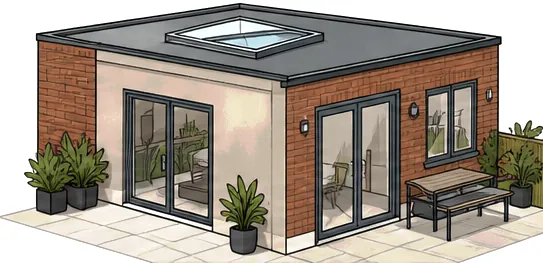
Higher up, and towards Stubbin, the stone gives way in places to rendered and brick houses of a later date. Their roofs are lighter and more regular, which makes them quicker to open up and flash. Some have been extended to the rear with a lean-to or a flat-roofed kitchen, and a flat rooflight on the extension is a quiet way to add daylight without altering the front of a house that sits in a row.
Pockets of bungalows and semis sit on the edges, with gardens that slope. Where a house is built into the hillside, the rear roof can be reached from the ground at one end and is a full storey up at the other. This is the sort of thing the survey is there to find, because it changes how we get glass up to the roof and what scaffold is required.
The slope also decides the exposure. Houses on the valley floor are boxed in by the hill and see more damp than wind, while those near the top of a street take the full force of weather coming along the valley. We read each roof for its aspect and its shelter, then pick a flashing and glass to suit, not one specification for the whole village.
Chimneys deserve a note. Stone terraces here often keep the stacks that once served a fire in each room, and a roof window beside a chimney breast needs careful flashing against the stone. Some stacks are shared across two houses, which limits where an opening can go. Where the stack has been taken down inside the loft but still stands on the roof, we check what holds it up before cutting near it.
Gutters matter on a hillside. Water running off a long, steep roof arrives fast, and a rooflight with a good flashing still depends on the gutter below it taking the flow. We look at the gutter line at survey, and if it is undersized, we say so, because a brimming gutter can throw water back under the covering. You hear what we saw in good time to have it seen to before the work starts.
The valley also offers dark mornings. Houses in the narrowest part of the dale lose direct sun for part of the winter, so a rooflight on the right slope makes a noticeable difference to a room that gets little light from its walls. We read the sun path at survey and recommend a slope and a size on that basis, not by habit.
On a Deepcar stone terrace the covering decides how a roof window ages. Stone slate and heavy tile sit on timber that has carried their weight for a long time, so the flashing is cut to the courses around the opening, and it is the first piece we look at, at year 5 and again after any hard winter. The glass unit, the blind and the opening gear come out from indoors while the flashing stays put, if the frame was chosen with that in mind. At survey we check the battens beside the opening, the state of the slates that will be lifted, and whether the neighbouring house shares the ridge, because a shared roof limits how much covering can be disturbed in one day.
Rooflights that work on Deepcar's slopes
The mix of old stone, small plots and valley damp points to a short list. Roof windows for lofts, flat rooflights on extensions, tubes for dark rooms, and replacement units for older lights. Each quote sets out which parts will wear and how they can be changed, with the roof left alone wherever the design allows.
 Conservation RooflightsFor stone slate roofs facing the valley road, where a flush frame keeps the lines of the slope.
 Roof WindowsBetween close rafters in a loft room above a stone terrace, where the frame has to be sized to the gap, not the room.
 Flat Roof RooflightsOn a small kitchen extension tucked behind a row, where a lantern would be seen from the lane above.
 Sun TunnelsFor a hall or bathroom with no outside wall, using a short tube through a shallow loft.
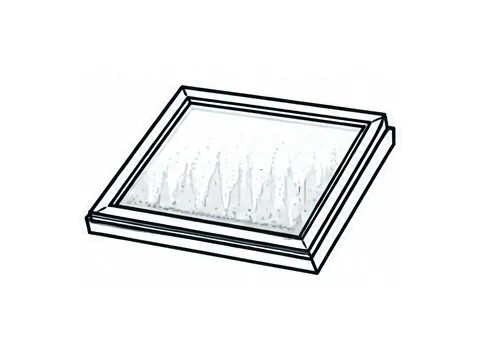 Misted & Failed Rooflight UnitsFor lights that cloud in the valley damp, where we work out whether the unit has failed or the room air is simply wet.
 Electric & Opening RooflightsFor a light set high over a stair, where a switch opens the sash and lets damp air out.
Consent and conservation in Deepcar
Sheffield City Council
Planning for Deepcar sits with Sheffield, even though the village feels a long way from the city centre. Roof windows in houses are usually allowed without an application, and the national conditions are covered on our page about planning and Building Regulations, which is where the figures live. Lanterns, and rooflights on a slope facing a road, are the ones we look at most carefully.
The council's data draws no conservation boundary around the heart of Deepcar. A designation can still sit on a single lane, so your address goes against the map at survey, and if anything turns up, you know before the quote exists.
Terraces split into flats do not hold the rights that a single house has for roof alterations, so a rooflight in a flat needs permission and normally the freeholder's agreement. Worth a call before a survey.
The village lies beyond the boundary of the Peak District National Park.
Conservation areas
The council's data draws no conservation boundary around the heart of Deepcar. Your address still goes against the map at survey, because a control can attach to one lane.
Deepcar and the valley towns
Stocksbridge is next door, about a mile to the north-west, and the two are joined by one valley road. Penistone is some four miles further along in the same direction, on higher ground with more exposure. Back down the valley, Chapeltown lies four miles to the east and Ecclesfield a little under five miles to the south-east, while Dodworth is just under five miles to the north and Hoyland about five and a half miles to the east. Stannington is to the south, around six miles off, in the hills above the Loxley valley. Each has its own page, because stone cottages in Penistone and estates in Hoyland do not call for the same advice.
Deepcar
A Deepcar rooflight, from the lane to the long run
-
The visit
Walking the plot as well as the roof
The valley road from Sheffield is 9.3 miles, about 23 minutes, and the survey is free. Before looking at the rafters we look at the access: the gradient of the lane, where the van can stand, and where glass will be lifted from. A scaffold on a sloping plot is a different job from one on level ground.
-
Fitting
Lifting stone and sealing the frame
On a stone slate roof the covering is lifted slate by slate, kept in order and re-laid. The frame is trimmed in between the rafters, and the flashing is formed to the profile of the stone. The guarantee on the fitting covers that junction, which takes the heaviest weather in a valley. Building Control is notified as part of the same job.
-
First damp season
Reading the glass in the wet months
Valley air holds moisture, and a new unit shows it first. Mist on the inner face means damp inside, which better airing can cure. Mist between the panes is a seal failure, and it is a different problem. We explain how to tell the two apart and what to do about each.
-
Year 7
A check on the parts under most strain
Around year seven it is worth checking the seals, the flashing edge and any opening gear. Houses higher on the hill see more wind-driven rain against the frame. The life plan names each part and how it comes out, so the job is a short one and the roof stays as it was.
-
Year 12
Replacing what the plan listed
By the twelfth year the plan from the quote has moved from a checkpoint to a job. A sealed glass unit that has misted comes out through the frame and a new one goes in, and the gaskets are renewed at the same visit. The slate or tile around the frame does not need to be lifted for this.
Deepcar and Stubbin: your skylight questions answered
My new rooflight is misting. Is the unit faulty?
Not necessarily. Mist on the inner face points to damp air in the house, which the valley produces plenty of, and better airing usually settles it. Mist between the panes means the seal has gone. We look at which it is before any work is proposed.
Does stone slate rule out a roof window?
No. The slates around the opening are removed one at a time and re-laid in order, the frame is trimmed between the rafters, and the flashing is formed to the profile of the stone. A flush frame suits these slopes well.
Can a roof window go beside a chimney stack?
Often, with care. The flashing has to be formed against the stone, and some stacks are shared with next door, which limits where the opening can sit. We check what holds the stack up before cutting near it.
Do Deepcar's lanes carry any heritage controls?
The council's data marks none in the middle of the village. The survey still includes a map check on your own lane, since a control can apply to one street and not its neighbour.
My plot is steep. Does that stop a rooflight going in?
It changes the logistics, not the answer. We look at the access, the scaffold and where the glass will be lifted from, and price the job with those in mind.
Do you cover Stocksbridge and Penistone too?
Yes. Both have their own page here, and the free survey applies across our whole area.
Can the glass or blind in a roof window on a stone terrace be changed later?
In many roof windows the glass unit, the blind and the opening gear come out from inside the room, which leaves the stone slate and the flashing undisturbed. That is worth having where the covering is heavy and hard to match. The frame itself is fixed into the roof, so at quote stage we write down which parts can be swapped from inside and which need the covering lifted. The maker's terms cover the parts, and our 10-year guarantee covers our workmanship in the fitting and flashing.