Skylights & rooflights in Meltham
Meltham is a stone-built town in a fold of the Pennine foothills above Huddersfield, with mill-era terraces, hillside lanes and newer estates sharing the slopes. Putting a skylight in, or taking a tired one out, begins with working out where the weather hits the roof.

What a Meltham hillside does to a rooflight
Meltham climbs. Streets that begin near the old centre rise quickly onto open ground, and the weather arrives from the moor with very little in its way. A rooflight that sits happily on a sheltered back slope can be a poor choice on a gable end facing up the valley, so the first question here is always which way the roof looks.
-
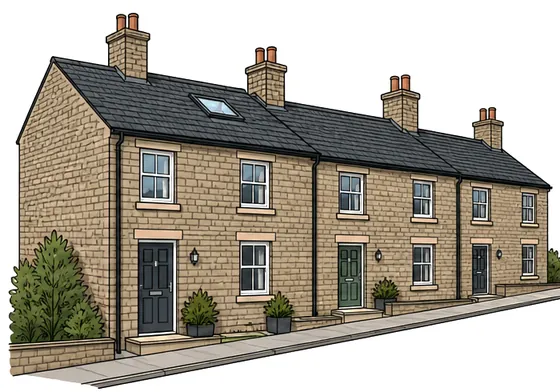
Stone roofs with a lot of weight in them
Older houses in the town wear heavy stone slates or thick natural slate on timbers that have carried that load for generations. We check how much the rafters have bowed before any opening is marked, because a frame fixed to a sagging slope will not sit square and the sash will rub.
-
Open slopes that take rain sideways
Up towards the moorland edge, rain comes in from the west with real force. On roofs like these the flashing round a roof window gets most of our attention, along with the way water is led off the lower edge of the frame.
-
Mill-worker terraces with a dark middle
The tall, narrow terraces built close to the old mills have deep rooms and small windows. Landings and back bedrooms in them get little light, and a roof window or a tube through a short loft is often the simplest cure.
Meltham's stone, street by street
Look at the older streets and you see how the town was put together: gritstone walls, stone slate or blue slate on the roofs, and rows of houses stepped down the slope so that each takes its level from the one above. Many began as homes for people who worked in the local mills, and some are still tall for their width, with attic rooms once used for storage. A window for one of those lofts is chosen to match the space between two rafters, not the floor area, and a slim frame looks more at home in old stone than a deep one.

Between the old streets and the open hill there are farmhouses, former weavers' cottages and larger villas, all in the same stone. These roofs tend to be steeper and the timbers heavier. That leaves room for a pair of windows, and it also makes every opening a job for careful hands, since stone slates are thick, brittle at the edges and not easily matched if one breaks.
Berry Brow, down the valley towards Huddersfield, shows how the hillsides filled in over time: stone terraces lower down, newer semis and bungalows above, joined by lanes that follow the contours. Bungalows are common on the later roads. In a bungalow the roof space is easy to reach, so a window or a tube can bring light into a hall that has none, and the ceiling height below is rarely a problem.
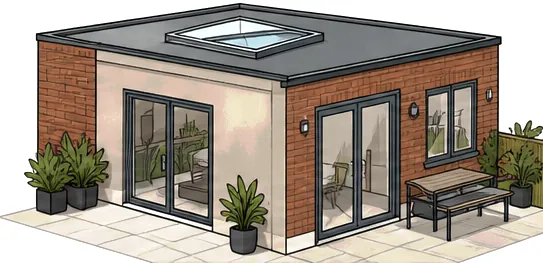
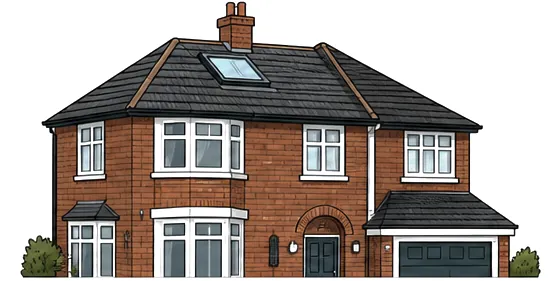
More recent building has added small estates of brick and reconstituted-stone houses under concrete tiles. Those roofs are trussed, so a cut that spans two trusses needs a trimmer designed to carry the load. Plenty of these houses also have a kitchen or dining extension behind, and the flat or shallow roof over it is where a lantern or flat rooflight has most to offer.
Because the town sits high, weather is a design factor here rather than a footnote. Snow lies longer on north-facing slopes, and a skylight that is opened for ventilation has to be one that closes tight afterwards. At survey we note how exposed the slope is and let that steer the glass, the seals and whether an electric opener earns its place.
Some homes also have stone outbuildings, converted barns or garage conversions in the grounds. A converted barn roof often has deep purlins and long spans, which suit large rooflights, but the structure behind the slates has to be read before any opening is drawn. We sketch the proposed position on the inside face of the roof with you, so you can judge the view and the light before a single slate is moved.
Rooflights that suit Meltham homes
Stone lofts take roof windows, flat-roofed extensions take lanterns and flat rooflights, and the dark corners of terraces and bungalows take tubes. Where an older unit has failed, swapping it is its own job. Whatever goes in, the quote lists what will tire first and how that piece comes out, so the choice looks past the fitting day.
 Roof WindowsFor attic rooms under the stone-slate and blue-slate roofs of the older streets, set between rafters and flashed into the slope.
 Conservation RooflightsFor stone cottages in the village core, where a low-profile frame leaves the roofline close to what the lane has always seen.
 Roof LanternsAbove rear extensions on the larger stone houses, where a deep room needs a pool of light from overhead rather than a wall window.
 Sun TunnelsFor a windowless landing or bathroom in a mill-era terrace, by way of a narrow tube down through the loft.
 Electric & Opening RooflightsFor lofts and high extension roofs that are hard to reach, where a motor lets you vent a hot room without a pole.
 Misted & Failed Rooflight UnitsFor older lights on exposed slopes that have gone cloudy inside the glass, where we ask first if the sealed unit alone could be swapped.
Kirklees rules and Meltham's old cores
Kirklees Council
Kirklees decides planning matters in Meltham, and for most houses the permitted development rules on roof alterations do not change at the town boundary. Instead of setting out the figures again we point you to our rooflights planning guide, which has them. One thing to know in advance: the height of a lantern above its flat roof is what we measure most carefully, because that is the dimension most likely to fall outside those rights.
The council's published data lists conservation areas at Meltham and at Helme. A house in or beside either has a street-facing roof that gets looked at more closely, and stone cottages in a village core are the likeliest to be affected. Your address is laid against the council's plan during the visit, and we say what, if anything, extra bears on the slope you have in mind.
Flats and maisonettes cannot lean on the permitted development route that houses can. If yours is in a converted building, a rooflight needs a planning application and usually the freeholder's agreement too. We ask about that early, before time goes into a design that cannot go ahead.
Conservation areas
The council's data lists conservation areas at Meltham and Helme. Your address is compared with its plan at survey, and we tell you then whether anything further affects the slope.
For a homeowner, the end of the job is a document: the completion certificate that follows the building control notification we make. Hold on to it. Solicitors acting for a buyer ask to see it, and an opening in a roof with no sign-off is the kind of gap that can stall a sale.
Neighbours across the Holme and Colne hills
Meltham is one of a group of small valley towns south-west of Huddersfield. Honley lies a short way to the east and Holmfirth a little further, to the south-east, both stone towns with the same weather and many of the same roof types. Lepton is further off to the north-east, on lower and gentler ground, and Skelmanthorpe lies further east. Over the tops to the south-west and south are Hadfield and Glossop, where the stone changes character and the Peak begins to show, and Penistone sits across the hills to the south-east. Dewsbury, to the north-east, is a very different town of mills and terraces. Each place has its own page.
Meltham
Up on the Meltham slopes: one unit, first visit to year ten
-
Survey
Reading a stone roof before we quote
The road from Sheffield is about 30 miles and 49 minutes, so we agree a visit date with you first. In the loft we measure rafter spacing, look at the underside of the stone slates for daylight and damp, and sight along the slope for any dip. Outside, we note how steep the lane is, where a van and a ladder can stand, and which way the roof faces the weather. If the house stands near a conservation area, we say so and show you a slimmer option beside the standard one.
-
Fitting day
Stone slate out, frame true, slate back
On older roofs the slates around the gap come away singly and are stacked for reuse, since matching stone slate later is hard. The frame is packed true against the rafters before it is fixed, and the flashing is bedded into the courses so rain crosses it and runs off. Inside, the opening is lined and given a splay so light spreads into the room. On a flat extension roof the kerb is built level, joined to the existing covering and tested with a hose before we leave.
-
First winter
Watching a new unit through the first hard weather
A high town makes a good test. After the first frost, check that the sash opens freely and the seals have not stuck. After a night of driven rain, look at the reveals inside for a damp mark. Mist on the glass on cold mornings usually means the room needs more air, not that anything has failed. A bathroom or kitchen below the unit is where it shows first, and a trickle vent or a wider opening settles most cases.
-
Year 10
The first checkpoint on an exposed slope
Ten years in, we would look at seals and opening gear first, because that is where wind and rain do their slow work on a hillside roof. Our 10-year guarantee on the flashing we fitted runs to this point, and your quote's plan for the unit says when that detail should next be inspected and how the glass or motor could be changed from inside, leaving the slates round the frame where they are.
Meltham households on stone, slate and weather
Do stone slates get in the way of fitting a roof window in Meltham?
They need care, not a different plan. Slates around the opening come away with the aim of reusing every one, the frame is packed true, and the flashing is bedded into the stone so rain sheds off it. How far the roof has bowed decides how much packing the frame needs, so we check that at survey. If a slate does crack, we say so on the day and put it right.
Will the weather up here be a problem for a rooflight?
It shapes the choice rather than ruling anything out. On open slopes we lean to a well-sealed frame, a flashing that sheds sideways rain, and glass suited to the exposure. An opening unit is worth having only if it closes tight in a gale, so we look at the gear as closely as the glass.
My cottage is near the middle of Meltham. Will that limit what I can fit?
It might, if the house lies in the Meltham or Helme conservation areas the council's data lists. We tell you at survey whether it does. If so, a slimmer unit that sits close to the slope is the first option we price, with the standard one alongside for comparison.
What do I receive at sign-off?
A completion certificate, issued after the notifiable work has been inspected. We make the notification ourselves, and the certificate is posted or handed to you for the house papers.
Can you light a landing in a terrace with no loft room?
Often, with a sun tunnel. A narrow tube runs through the roof space from a small dome on the slope to a diffuser overhead on the landing. A clear route between the rafters is the thing we check before saying yes.