Skylights & rooflights in Brimington
Brimington, on Chesterfield's north-eastern flank, keeps older brick and stone along its main road and fills out with semis and bungalows beyond. Our work here is putting skylights into lofts and extensions, and replacing tired ones, with units built so that the seals and the glass can come out one day without a new roof.

Where Brimington roofs set the terms
A village that has been added to over generations carries several kinds of roof in a few streets. A single rooflight specification does not fit all of them, so we look at each house on its own terms: the covering, the pitch, and what has been built on since.
-
Older roofs with worn coverings
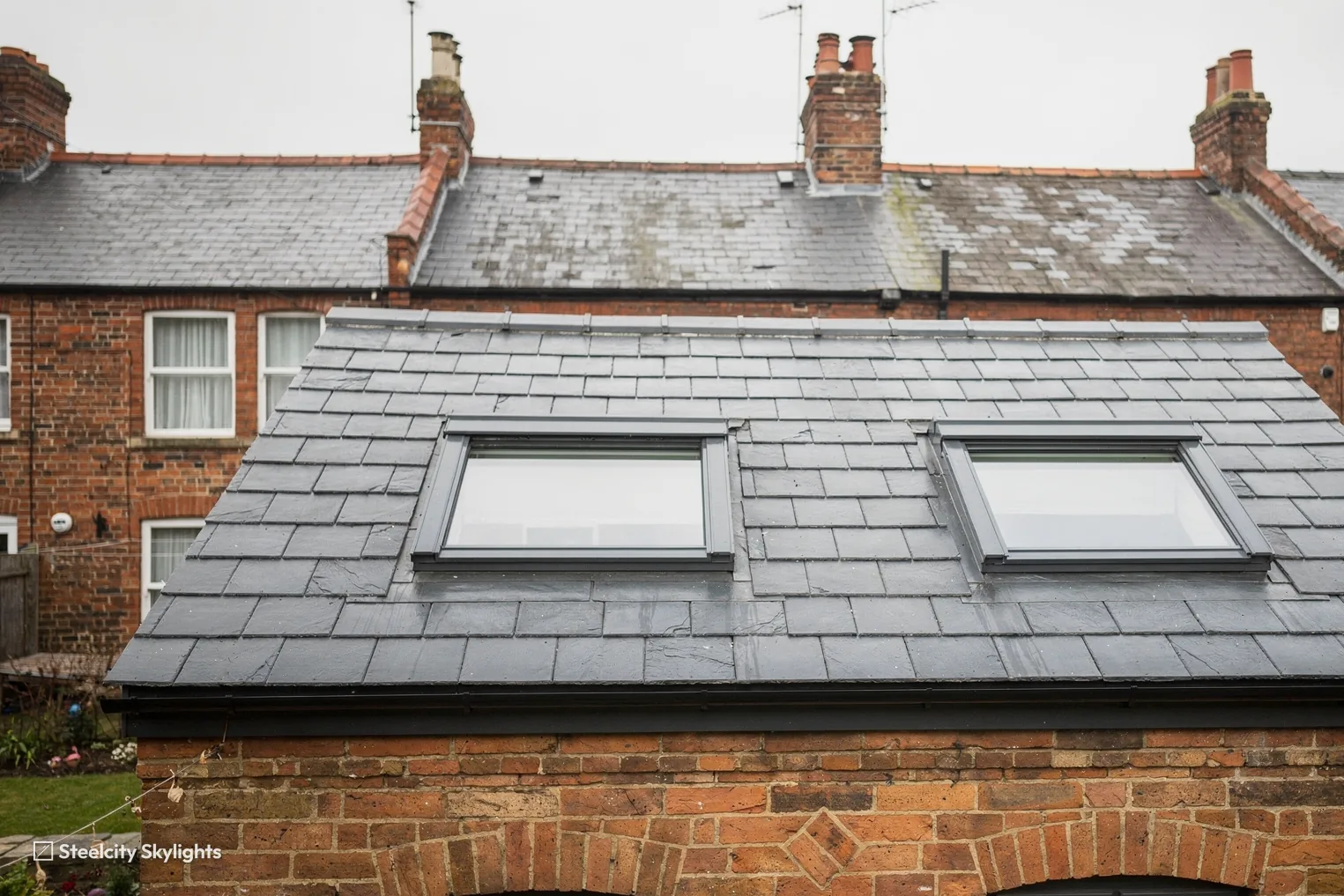
Houses close to the main road include some that have carried the same slate or clay tile for a long time. The covering around a new opening has to be lifted and relaid, and where it is brittle we say so, because cutting into a tired roof can cost more than the rooflight itself.
-
Semis and bungalows with deep floor plans
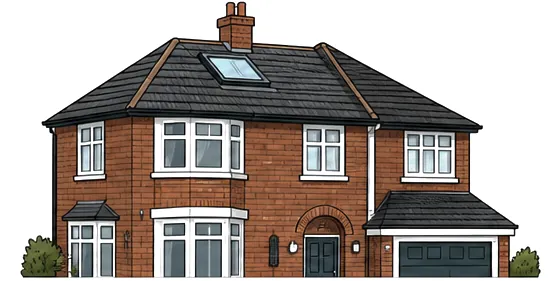
The inter-war and post-war housing tends to be deeper than it is wide, which leaves landings, bathrooms and kitchens a long way from the windows. Daylight from above fixes this better than a bigger window on a wall that is already full.
-

Roofs on the rising ground towards the Common
As the village climbs towards Brimington Common, roofs face more open sky and take more wind. The direction a slope faces, and whatever stands in its way, decide how hard the seals and flashing have to work, so the site is read before the unit is chosen.
Brimington's houses, road by road
The village core runs along its main road, and the older houses there are a mix of brick and stone cottages and short terraces, many of them altered over the years. Their roofs are steep enough for a loft room but low, and the timbers can be modest. A roof window here is fitted between the rafters wherever it can be, and a slender frame looks better on an older slope than a bulky one.
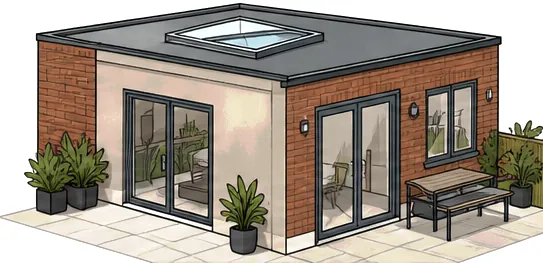
Between the wars and after, Brimington spread outward in semi-detached rows and short terraces, with a smaller number of bungalows mixed in. These houses commonly have simple pitched roofs in concrete or clay tile, and many have a kitchen or dining extension at the back. The extension roof is where a flat rooflight or a lantern is most useful, because it lights the part of the house furthest from the garden.
Later estates on the edges, towards Calow and Brimington Common, brought detached houses and larger semis with trussed roofs. A roof window between two trusses is a straightforward job there. A wide lantern over a conservatory-sized extension is a bigger decision, because the joists have to be trimmed and the opening approved before we start.
Because Brimington sits on rising ground north-east of Chesterfield's centre, a house can feel sheltered on one street and exposed on the next. On the Common side the roofs catch more weather and we pay closer attention to flashing detail. In the lower streets the concern is more often damp air from a busy kitchen, which can leave a film of moisture on the inner pane when the weather is cold. A trickle vent or an opening rooflight is usually enough to deal with it.
Bungalows and dormer bungalows deserve a mention. Their roofs are low enough to reach from a ladder at the eaves, and their ceilings are often flat plasterboard under a trussed roof. That makes a sun tunnel an easy answer for a dark hallway, and a roof window an option where the bungalow has a room in the roof.
One more point about the semis and bungalows that fill so much of the village: their roofs were usually built to a standard that predates today's insulation levels. When we cut a new opening, we look at what lies around it. A fresh frame in a thinly insulated roof can leave a cold ring in the ceiling that shows up as a dark mark within a winter. Lining the reveals fully and lapping the insulation onto the frame avoids that, and it costs very little extra if it is planned from the start rather than added afterwards.
The semis and short terraces from between the wars are worth following through the years. On a tiled roof the seals and the flashing give out first, and the flashing is tied to the tiles around it. A blind, a pole or a lining is a room-side job. The sealed glass unit is held in the sash and is reached from the roof. Before quoting, we lift a tile or two beside the proposed opening to see the battens and underlay, and set the rafter spacing against the frame size. An underlay that has perished is better known about before the quote than found on the day.
What goes where in Brimington
Brimington's lofts, back extensions and worn-out lights each call for a different answer. Older and converted lofts take roof windows, flat roofs take fixed glass or a lantern, and a failed unit is swapped for an insulated one. Every quote sets down which parts will age first and the way each is changed, which keeps the choice honest over the long run.
 Roof WindowsFor loft rooms under the pitched roofs of the older streets near the main road, flashed into slate or tile and sized to the rafter gap.
 VELUX WindowsFor semis and bungalows on the estates, where a standard size code drops into an existing opening or a new one between trusses.
 Flat Roof RooflightsFor the low roofs over kitchens and utility rooms at the back of inter-war semis, where one fixed pane lights the room evenly.
 Roof LanternsOver the longer extensions on the newer streets towards Calow, where the dining area sits far from the garden doors.
 Energy Efficient RooflightsFor extensions built when thermal standards were lower, where an older roof light loses a lot of warmth and a new unit makes a noticeable difference.
 Walk-On RooflightsFor ground-level patios and flat roofs used as terraces, where glass lets daylight through into a room below while still taking footsteps.
Consents for Brimington rooflights
Chesterfield Borough Council
Planning in Brimington is decided by Chesterfield Borough Council. A house can generally take a roof window or a close-fitting rooflight without a planning application. The tests are national, so we leave them to our guide to planning and Building Regulations. A lantern is the unit we measure twice, since a tall one can step beyond what those rules allow.
Chesterfield Borough Council has supplied none of its conservation boundaries to the government's planning dataset, so that source is silent about the middle of the village. Rather than tell you there is nothing to worry about, we open the council's own conservation map at survey and look for your street. If a control turns up, we recommend a flush conservation unit and say so before the quote.
A house divided into flats loses the permitted development rights a single house has, so a rooflight in a conversion must have planning permission, and the freeholder has to agree. We raise this at the first call, so a design is never drawn up for a roof where the answer will be no. A rooflight that shows from the road on a corner plot or a house facing a green is also worth thinking about early, because neighbours notice a new opening on a street-facing slope more than one at the back.
Conservation areas
Brimington falls to Chesterfield Borough Council, whose conservation boundaries are absent from the national dataset, so the records say nothing either way here. At survey we search Chesterfield Borough Council's own conservation map for your street.
Building Regulations apply to rooflight work wherever it is, and we handle the notification. What reaches you at the end is a completion certificate from the council or a registered building control approver, which you should keep with the house papers for a future sale.
The Brimington area, from Staveley to Chesterfield
Chesterfield is 2 miles south-west of Brimington, and Staveley is 2 miles east. Eckington lies 3.9 miles to the north-east. Wingerworth is 4.1 miles south-west and Dronfield 4.5 miles north-west. Bolsover lies 4.7 miles south-east, Mosborough 4.8 miles north and North Wingfield 5.3 miles south. The page for each sets out what its roofs are like. Chesterfield itself has everything from older brick terraces to larger houses on its edges, while Staveley and Eckington are mostly family terraces and estates with their own mix of roofs. Mosborough and Dronfield sit northward, on the Sheffield side. Brimington Common and Calow, which merge into the village on its edges, are within our area as well, and the same roof questions apply there.
Brimington
Brimington, from the first look to the next decade
-
Survey
Reading the roof before we quote
Coming from Sheffield, Brimington is 11.6 road miles south, roughly 24 minutes' drive, which makes a survey easy to fit around you. Once in the loft we study the rafters or trusses, the state of the covering and the insulation. On a flat-roofed extension, the deck is what we examine, and we ask where water already collects. We also check the council's conservation map for your address.
-
Fitting day
Opening up a lived-in house
Houses here are usually occupied during the work, so we hang dust sheets in the loft and keep the room below covered. The opening is trimmed, the frame set square on its packers, and the flashing dressed into the covering. The room side is lined and insulated before the day finishes.
-
Guarantee
What the 10-year guarantee holds us to
The 10-year guarantee applies to our workmanship on the flashing, which is the part of a roof window that decides whether the roof stays dry. If a flashing we fitted lets water in during that time, we put it right.
-
Year 10
Seals, hinges and the plan you were given
A decade in, the seals on a roof facing the Common will have worked harder than those on a sheltered street. The life plan lists which seals, which hinges and which glass unit we expect to look at first, and how each is changed. For most roof windows that happens from inside the room.
Before a Brimington survey: what people ask
Does a conservation area cover my Brimington street?
None of Chesterfield's conservation boundaries have been fed into the national dataset, so that data cannot settle it. At survey we open Chesterfield Borough Council's map, find your street and tell you what we see.
Is an older tiled roof in Brimington a problem for a roof window?
Yes. Tiles at the opening are taken off and put back, and the frame is set between the rafters where the spacing allows. If the covering is brittle, we say so at survey, since cutting into it can make the repair larger than the window.
Will a lantern work on a semi whose kitchen extension has a flat roof?
Often, yes. We trim the joists, build an insulated upstand and seal the covering up to it. Joist direction and lantern height both get settled at the visit, since a tall lantern can need planning permission.
What happens on the Common side where the wind is stronger?
We note which way the slope faces and pick the flashing and seals accordingly. On exposed roofs we pay closer attention to the head and sides of the flashing, where wind-driven rain gets in first.
Do you cover Calow and Brimington Common as well?
Yes, both are within our area, and we survey them exactly as we do the village. The neighbouring towns are covered on their own pages.
Does a Brimington semi need new tiles around a roof window?
Not all of them, but some may. The tiles directly around the opening are lifted and relaid, and any that crack or no longer match are noted at survey so that a spare can be sourced before fitting day. Older tile can be brittle when it is lifted, which is why we look at it first and say in the written quote how many might need replacing.