Skylights & rooflights in Skelmanthorpe
Skelmanthorpe is a stone-built village in Kirklees, on the West Yorkshire side of the county line, with cottages, terraces and newer estates side by side. Our work in the village covers new and replacement skylights, roof windows and lanterns, and every unit is picked so that the parts which age can be changed later and the roof stays whole.

Skelmanthorpe roofs: what to look at before cutting in
This is towards the north-western edge of our area, and it feels like it: a village of local stone and slate, a short way from the Holme Valley and the Barnsley side. The roofs are plain and old, and a rooflight has to fit into them without drawing the eye. We start by looking at what is there before we say what could go in.
-
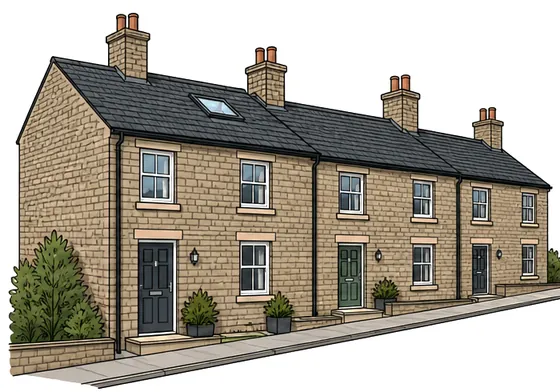
Stone walls and heavy old roof coverings
Houses built from local stone carry heavy stone slate or thick old slate on rafters that were cut by eye. Before a frame goes in, we check how the weight sits on the timber and whether a section of the roof must be relaid so that the flashing has a sound bed.
-
Small loft spaces under low ridges
Cottages and terraces built a long time ago have low ridges and attic rooms that run to the eaves, so the headroom is a narrow strip down the middle and the sloping part is little use for standing in. A rooflight here has to be the right size for a modest roof, so we measure the gap between rafters and the height under the ridge before we suggest a unit.
-
Open ground and a lot of sky
Skelmanthorpe is high enough and exposed enough that wind is part of the picture. A flashing that holds when rain blows sideways, and frames that are fixed to withstand gusts, are what keep a rooflight dry on the ridge. We choose the fixings for the worst day, not the average one.
Skelmanthorpe's houses, old centre to new estate
The old part of the village is built in local sandstone, and the age of a street is usually plain from its roofline, and many of the oldest houses are cottages and short terraces with stone-slate or slate roofs close along the main street and the lanes off it. The attic rooms are small and sit hard under the roof, and some of the houses have been altered several times over the years. A conservation-style unit with slim frames sits well in these roofs, and we have to size it carefully around the rafters.

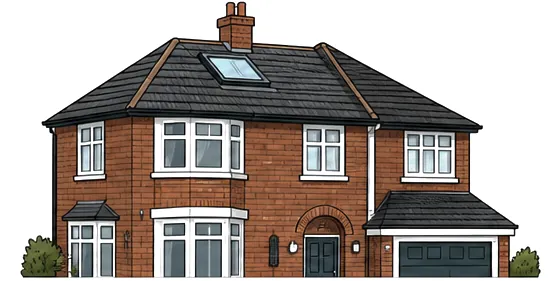
Beyond the centre the village spreads out in later phases. There are rows of stone and brick terraces built when the place was a working industrial village, then inter-war and post-war semis with concrete tile or modern slate, and newer estates on the edges built with trussed roofs. The trussed loft is a lattice of timber, and an opening in it needs structural thought. Semis and bungalows are more straightforward, and a rear-slope roof window or a flat rooflight over a back extension can change a room.
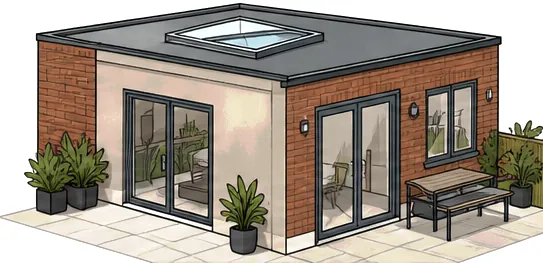
Rear extensions are common behind the village's houses, built over the last few generations, usually with a flat or shallow roof above a kitchen or dining area. That kind of roof is a fair candidate for a lantern or flat rooflight, as long as the joists underneath are in good order and the covering can be joined to the upstand. At survey we check which way the joists run and what the existing covering is made of.
Skelmanthorpe is a village, so access is usually easier than in the steep Holme Valley towns to the west, and a van can often stop close to the house with room beside it for the glass. Driveways, back gardens and side passages make it straightforward to bring in glass and set scaffold. That leaves more of the survey to spend on the thing that matters, the condition of the roof timbers and the covering. Where the roof is old, we put a hand to the underside of the slope from inside, press on the battens and look for daylight, soft timber or old stains, because those tell us whether the frame can be fixed to something solid.
Stone-slate roofs on the older cottages need a different approach from tile. The slates are thick, uneven and heavy, and the battens beneath them carry a real load. Around a roof window the flashing has to be cut and dressed to follow the stone, and the slates beside the frame are set back in their own courses. Years later the flashing and the sealant lines are what wear, and the glazing can be swapped from inside on most models without disturbing the stone. A slim frame with a low profile suits these roofs, as it sits close to the slope. At survey we check the battens for rot, count the courses and decide which slope can take the opening without losing sound slates. Where a slate has slipped or cracked, we say so before the frame goes in.
Roof glazing for Skelmanthorpe's cottages and estates
Housing sets the list: roof windows into cottage and terrace lofts, flat rooflights and lanterns over back extensions, tubes for inner hallways, and fresh units where an older light has given out. A quote here lists the parts of each unit that age and how they are replaced, so the decision rests on more than the glass.
 Conservation RooflightsFor the stone cottages near the centre of the village, a slim, flush frame that keeps the old slope looking as it always has.
 Roof WindowsFor the attic rooms of terraces and semis, fitted in the space between rafters and weathered into stone slate or modern slate.
 Roof LanternsOver the rear kitchen and dining extensions added behind village houses, where the centre of a deep room gets no help from a wall window.
 Flat Roof RooflightsA low, quiet choice for a flat extension roof that sits under a bedroom window, where a lantern would rise too far.
 Energy Efficient RooflightsFor exposed rooms on the ridge, where a unit with a good frame break and a warm-edge glass spacer keeps the room comfortable.
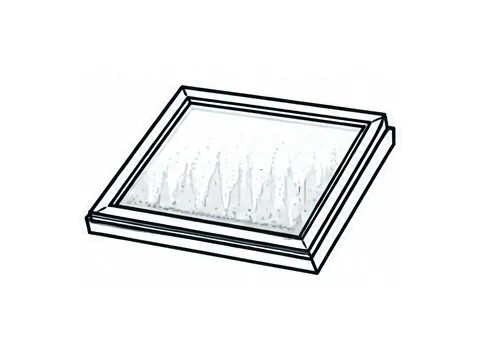 Misted & Failed Rooflight UnitsFor rooflights fitted to older extensions that have gone cloudy inside the sealed unit, so we begin by asking if a replacement pane alone would be enough.
Skelmanthorpe: Kirklees planning and the village conservation area
Kirklees Council
Skelmanthorpe is in West Yorkshire, and Kirklees Council is the planning authority, so its own policies and map apply. Whether roof windows and shallow rooflights need permission depends on national rules, and the guide linked below explains them, so we leave them out of this page. If a project looks likely to stray outside those rules, the point is raised at survey.
The council's records list a conservation area in Skelmanthorpe, near the centre of the village, and it is worth knowing where its edge falls before a design is settled. Inside it, the street-facing slope gets more attention than the back, and a slim, flush frame in a dark colour is usually the place to start. At survey we find out from the council's map whether you are inside the boundary and whether extra controls apply.
Some of the older houses in the village have been divided, and roof work on flats and maisonettes sits outside permitted development. A new rooflight in one needs the council's consent, and the freeholder's agreement is normally needed too. This comes up in our first call, before any survey is booked, so the plan starts on firm ground.
Conservation areas
Skelmanthorpe has a conservation area marked on the council's map. Your address is matched to the council's map, and any extra controls it shows are handled before the design is fixed.
When the work is done, you receive the completion certificate for the installation. Building Control is notified by us, and the inspection is carried out by Kirklees or by a registered building control approver. Put the certificate in the folder with your title deeds; a future buyer's solicitor will want a copy.
Skelmanthorpe and the villages around it
Skelmanthorpe sits among the Kirklees, Barnsley and Wakefield places towards our north-western edge. Lepton lies under four miles to the north-west, with Penistone about five miles south, and Darton and Barugh Green a similar distance to the east. Holmfirth and Honley are six miles west, in the Holme Valley, with Dodworth six miles south-east and Crigglestone six miles north-east. Every one of those is within reach, with a page of its own on this site. The tighter stone streets of Holmfirth and Honley ask for a different approach than the open estates of Darton, and each is written up for its own housing.
Skelmanthorpe
Skelmanthorpe: what happens once the survey is done
-
Survey
Reading the timber under the stone
Skelmanthorpe is 25.7 road miles north-west of Sheffield, about 39 minutes by road, so a survey is straightforward to arrange. On the roof we check the covering, the pitch and the rafters beneath; inside, we look at the loft for damp and at the way the old timber has settled. On a flat extension we check the joists and the covering. If the address is inside the conservation area the council lists, we say so, and show you a flush unit next to the usual type.
-
Fitting day
Relaying stone slate round a new frame
Stone slate and old slate are lifted by hand, kept in order and relaid, because matching them later is difficult. The upstand where a flat rooflight meets the existing covering falls under the 10-year guarantee we give, and we test that joint with water before we leave. The room underneath is covered until the unit is weathertight.
-
First spring
What a year of weather has done
After a winter and the first mild days, look over the new rooflight. Check the reveals for any trace of damp, work the sash open and shut, and watch how fast the glass clears on a cold morning. A bird's nest or a fall of leaf in the flashing is easy to clear at this stage, and if anything looks wrong, tell us now, while the work is new.
-
Year 10
The wearing parts at the ten-year mark
A decade on, the seals on the sash and the edge of the glass unit are the parts we look at. Your written plan lists them, along with any motor, and describes how each is exchanged, indoors or on the slope, and whether stone slate has to be lifted. Because it was agreed at quote, nothing about the work is a surprise.
Skelmanthorpe homeowners ask about rooflights
Which council deals with planning in Skelmanthorpe?
Kirklees Council, because the village is in the Kirklees district of West Yorkshire. We use its planning map and policies when we advise you, and we check your address against its conservation area boundary at survey.
Will a roof window suit an old stone-slate roof?
Yes. Stone slates come off by hand around the opening and go back in order once the frame is in, and the frame is sized to the rafters already there. A slim frame often looks best in an old stone slope.
I have a flat extension at the back. What suits it?
A flat rooflight or a lantern. The choice depends on how high the ceiling is, whether a bedroom window sits above, and what the joists and covering can carry. We check these at survey and tell you which works.
Do I need Building Control for a new rooflight?
Usually yes, because a new opening is structural work and replacing a window is controlled work. We handle the notification, and you receive the completion certificate when the work has been inspected.
Do you work in the other villages nearby?
Yes. Lepton, Darton, Barugh Green, Dodworth and Crigglestone are covered, as are Penistone, Holmfirth and Honley, and a separate page on this site deals with each.
Does a conservation area apply to my stone cottage in Skelmanthorpe?
The council's data lists a Skelmanthorpe conservation area near the centre, though no designation date is shown. We check Kirklees council's map against your address at survey. A conservation area does not remove permitted development for rooflights on its own, but an Article 4 direction can, so we confirm before choosing a unit.